Showing posts with label Mathematics. Show all posts

Saturday, April 21, 2012

Maths Questions :)

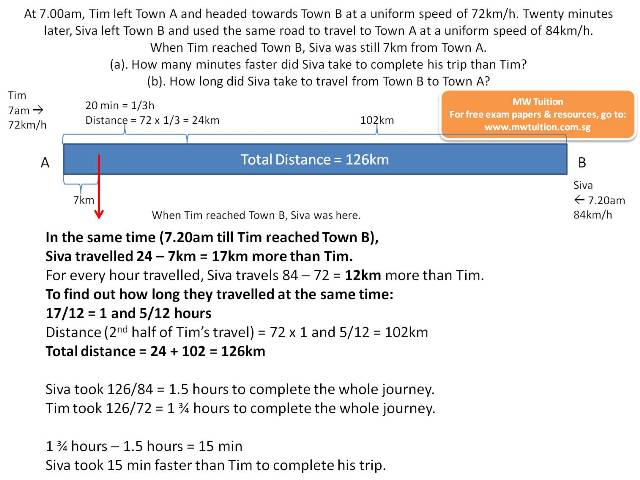
Primary School Maths Questions & Solutions :D

P3:

P5:


P6:


Monday, November 21, 2011

Have a Maths question????

I've been receiving quite a few SMS/emails from parents asking for help with Maths questions.
As such, I've decided to start a FB group to tackle such questions.
We can post up questions and anyone who can help can simply reply with the solutions!

Do join the group! https://www.facebook.com/groups/203788813032911/#!/groups/203788813032911/

Friday, May 13, 2011

SA1 is over... Now... What???

Now that SA1 is over, many students are starting to receive their results.

As parents/tutors, what's the next step?

1. Go through & analyse the mistakes made in the papers.(a) Careless mistakes - defined by marks lost due to calculation mistakes, poor handwriting, copying of wrong words/spelling/numbers
(b) Failure to pay attention to details - defined by marks lost due to child skipping important info given in the question (such that when the info is highlighted to them, they are able to get the answers without help).
(c) Failure to understand concept/apply - defined by marks lost due to total lack of understanding for the question/concept.

To tackle careless mistakes, you have to be patient and constantly remind them. Add up the marks lost due to careless mistakes and let them feel the impact (and see the difference between the score they could actually obtain vs the score they obtained).
Also, remind them that is it human to make mistakes (as in lost a few marks) but they can try to minimise it by checking, recalculating & reading carefully.

For children who fail to read the questions carefully, it would be good to encourage them to underline/highlight important key words in the questions. Make it a habit by ensuring that they do that all the time - for school homework and additional work done at home/tuition.

Failure to understand/apply concepts:
We will have to go back to basics for those topics. Go through the basic content knowledge. Then go progressively upwards to re-teach the entire topic.
Some children require constant reminders/revision. If your child need this, plan for the exam revision to start earlier. Then, a few days before the exam will be a quick run through of all the topics & key concepts to note.

2. Analyse what has been done during the studying/revision process & how to improve(a) Was there adequate time allocated?
(b) Did revision start too late?
(c) Was the wrong method used for revision?

If a particular method of studying has been identified as useful, build on it.
If your child hasn't found his/her preferred method, explore other methods together.

3. Encourage & assure your childNo matter the results, all children need encouragement.
For those who scored well, encourage them and motivate them to score better.
For those who did not score well, encourage them to take the first step to doing better. Don't expect an overnight change in your child - it's not realistic. Set small realistic targets with deadlines. For example, you can set the first target as: Revise P3 Diversity Topics and practice related questions by end of 1st week of June holidays. Then, guide your child in work division and daily work allocation to manage his/her time. Follow up by physically checking their work (not just verbal checking by asking them if they've done their work).

Always remind them that you love them. Though you may be disappointed with the results, they are your children and you will still love them. Love is unconditional.
Explain to them why you feel disappointed - you know they are smart kids who can achieve more!
Slowly build the confidence in them, encourage them to be self-motivated.
Children forget easily, you may have to repeat this 'talk' a few times for it to really sink in, especially for the younger ones.

4. Re-look their schedules

Could your child be too tired out from tuition/enrichment classes to focus on studies?
Would it be wise to drop 1 or 2 activities to focus on building up the academic studies, then having those activities again later on?

I personally re-looked my 4yo boy's schedule recently. Though we've always stuck to 'only 1 enrichment class a day', I noticed he had less time for play & socialising (at the playground). We took a bold step and cut down on the enrichment classes (though my KS-parent mind is saying: WHAT IF HE LOSES OUT!???).
I'm glad I did that as he has more time 'day dreaming' and coming up with new stories & games, more time to read storybooks and have been more receptive to spending time sitting down with my hubby for informal Chinese lessons (reading, simple writing, speaking in Chinese).


I hope that parents & students will not be discouraged by the results. This is only SA1, there's still time to catch up.

Saturday, April 16, 2011

SA1

It's that time of the year again. SA1 is approaching in a few weeks. While students are still oblivious to it, parents and tutors (myself included) are starting to get nervous.

By now, most schools have yet to finish teaching the topics to be tested in the SA1. On my end, I'm worried that my students will not fully grasp the concepts of the coming topics which their teachers will rush through. I'm glad I've covered those topics during lessons with them but am nervous about them being able to handle the application questions (especially for Maths & Science).

Worries aside, now is the time to start revision.

For English:
- Ensure that they have a habit of underlining/highlighting clues & making annotations.
e.g. Every (singular) member in my family ___ to eat fish. We eat it everyday (present tense).
1. like
2. likes (singular, present tense)
3. liked
4. has liked
- Make it a habit to read through for hidden meanings (for vocab).
- Write down the words together with the alphabets so that you can read the passage as a whole (for grammar cloze).
- Read the passage carefully and determine if there are clues and draw arrows to link the clues back to the blanks (for compre cloze).
- Highlight where you got your answers from (graphic/compre MCQ/compre OE). Ensure that your answers are in full proper sentences with the correct tenses based on the question. Always check the question word to ensure that you are answering the question.
e.g. Why (reason) did (past tense) the boys run off when they saw the shadow?
Wrong: The boys saw the shadow and ran off to the nearest exit. (This is an ACTION, not a REASON).
Correct: The boys ran off when they saw the shadow as they were afraid that it might be a monster or a ghost.
- Synthesis & Transformation: Check the clauses carefully.
e.g. 'Unless' always has a positive & negative part.
Unless you complete your homework (POSITIVE), you will not (NEGATIVE) be allowed to watch television.
- Editing: Check the TENSES carefully. Also, to check your spelling, write it on a different page (in pencil) without looking at the wrong spelling given. Sometimes, the wrong spelling may confuse you and cloud your mind. Writing out the word again on another page might take away the false impression of the 'wrong' spelling.

For Maths:
- Calculation mistakes should always be avoided. Using logical thinking, if you are adding up numbers, the final answer should be larger than the original numbers.
- Break long questions into smaller parts. Read and understand what information is given in each sentence before reading the next sentence. Underline/circle key numbers and draw arrows to the names/objects if it helps. Else, you can rewrite the info on the side to help you.
e.g. Tony had 15% more 50c coins than 20c coins. If there were 6 more 50c coins than 20c coins, how much money did Tony have?
Rewriting the info given:
Tony
15% more 50c coins than 20c coins  (100%)
50c coins -> 115%
20c coins -> 100%
6 more 50c coins than 20c coins
-  Identify the technique needed to solve the problem (constant difference, etc). If in doubt, draw a simple model to compare the information given for a clearer picture.
- Always check to ensure:
(a) All questions have been attempted.
(b) Double check all calculations. *this is when mental calculation will come into good use
(c) Double check that all working has been shown clearly.

For Science:
- Read questions carefully.
- Underline/circle key words in the questions.
- Identify the topic it is related to so that you know what type of answers are expected.
- For MCQ: Always eliminate other answers even if you are sure that your answer is the best answer. Sometimes the meaning of the option could change with ONE word.
e.g.
(1) Most of the mammals give birth to young alive.
(2) All mammals give birth to young alive.
Option 2 is wrong as not ALL mammals give birth to young alive, there are exceptions like the platypus. So in this case, Option 1 is a better answer.
- For open-ended questions, ALWAYS WRITE IN COMPLETE SENTENCES even if the answer seems direct and simple.
e.g.
What energy is needed?
Answer: Heat
You should write your answer as: Heat energy is needed. Or: The energy that is needed is heat energy.

Hope that these tips and reminders will be helpful!!

Wednesday, January 26, 2011

Another Maths Question...

$260 is to be divided among a certain number of people. If half of the people receive $3 each, one-eighth of the people receive $2 each and the rest $4 each, how many people are there altogether?

Divide the people into 8 units (based on 1/8 of the people):
1/2 => 4 units (recieved $3 each) x $3 = $12u
1/8 => 1 unit (recieved $2 each) x $2 = $2u
Remaining => 8 - 4 - 1 = 3u (received $4 each) x $4 = $12u

Total amount of money = $260 => $12u + $2u + $12u = $26u

$26 u -> 260
$1 u -> 260/6 = 10

Altogether there were 8 units of people

8 u -> 80 people

A P6 Maths Question from Workbook

Adam and Rahmad shared some beads. If Adam gave 1/3 of his share to Rahmad, Rahmad would have 70 more than Adam. If Adam gave 1/5 of his share to Rahmad, Rahmad would have 10 more than Adam. How many beads does Adam have at first?


If Adam gave 1/3 of his share to Rahmad...

A [----][----]
R [----][----][ 70 ]

Which means that Adam will have 2 units left while Rahmad will have 2 units plus 70 more.
Adam would have a total of 3 units at first.

If Adam gave 1/5 of his share to Rahmad....

A [--][--][--][--]
R [--][--][--][--][ 10]

Which means that Adam will have 4 units (different from the first model) left while Rahmad will have 4 units plus 10 more.
Adam would have a total of 5 units at first.

BASED ON SAME TOTAL for Adam (3 x 5 = total 15 units),
We can change the units into....

If Adam gave 1/3 of his share to Rahmad...
All units multiply by 5 to get a total of 15 units at first:

A [-][-][-][-][-][-][-][-][-][-]
R [-][-][-][-][-][-][-][-][-][-][ 70 ]

If Adam gave 1/5 of his share to Rahmad....
All units multiply by 3 to get a total of 15 units at first:

A [-][-][-][-][-][-][-][-][-][-][-][-]
R [-][-][-][-][-][-][-][-][-][-][-][-][ 10]

Comparing the above 2 models, we can see that 4 units = 70 - 10 = 60

1 unit = 60/4 = 15
15 units = 15 x 15 = 225 


From: http://www.kiasuparents.com/kiasu/forum/viewtopic.php?t=280&postdays=0&postorder=asc&start=2320


The school teacher's answer is 450 which many parents have debated to be wrong.

Pushing Your P6 to PSLE

In response to this thread: http://www.kiasuparents.com/kiasu/forum/viewtopic.php?p=346466&highlight=#346466

I've posted the following:

or T1 in P6, it's good to focus on the new topics: algebra, speed, circles.

What I'm doing with my students now: Going through the above topics and revisiting percentage, ratio and fraction.

They are starting off with CA1 papers from top schools (1 paper a week).

By end term 1, I would have completed teaching all the topics and we will start more intensive work by starting on challenging problem sums for P6 topics.

By June holidays, it will be intensive Q&A. They try, they ask, I clarify.
Usually by end July, my students will finish their stash of past year exam papers and I'll dig out different challenging questions or revisit certain 'techniques' or 'topics' which they have problems with.

After that, it will just be enough work to keep momentum going.


***
I encourage students to PLAN THEIR TIME WELL.

For my students, I normally encourage this:
Weekdays: Focus on school homework. Once complete, try to do exam papers (if can't finish the whole paper, at least 1 section of the paper).

Weekends: Set aside 2-3 hours a day to finish up the exam papers.

Tuition should comprise of practice papers -> Your kid's tutors don't give them papers to practise? Or they give them in other forms (compiled worksheets)?

My students normally finish the other work (trying new questions/techniques) during lesson, so most of their homework is exam paper (1 per week) and probably around 5 pages of homework per subject.

On top of that, they have to write a compo a week and finish compre OE, compre cloze, S&T, etc.

So far my students all managed to manage their time well with guidance.

You have to teach them to manage their time. And also teach them to plan/spread out their work.

When I assign homework, I normally will show them how to split up the
work so it becomse manageable.


If your child's time is totally occupied by enrichments/tuition, then it's time to rethink your strategy. I personally believe in only have 1 enrichment/tuition class PER DAY. Nothing more (they can't absorb).

With 1 enrichment/tuition class per day, it is definitely manageable. Even my lazy students managed to finish their schoolwork on top of tuition work. And sometimes, they give me a nice surprise by finishing more work than I expected. Very Happy & she still have piano classes and Chinese tuition. She comes to me 4 times a week!


***


The jump from P4 to P5

Key things to note in helping P5 kids cope with increased volume in questions in P5 English Exam Format:

1. Read Read Read. Instill the habit of reading at least 1 news article a day. If you don't subscribe, read online news and print out 1 or 2 interesting articles a day to get your child interested. Choose an article which is in hot discussion or may interest your child. Draw a word mindmap (using the main topic, branch out related words) to increase vocab and also to understand that certain words will be used in certain scenarios.

2. Have a dictionary ready within easy reach. If budget permits, get an electronic one which can store a word list which you can upload onto the computer and print out. If using the hardcopy, make sure your child knows how to use it.

3. When reading, highlight phrases that always go together (phrasal verbs). E.g. He was taking down the poster when he fell off the ladder.
They will need phrasal verbs for Compre Cloze.

4. Make it a habit to underline/circle/highlight KEY WORDS/CLUE WORDS.
This is what I teach in class for Compre OE/MCQ: Take note of the QUESTION WORD, the clue word (tenses) and the key word (what are they referring to in the question). And if need, make simply annotations. E.g. *circle* "WHY" *write8 " --> REASON" Which means that the question is look for a REASON (not anything else).

5. For S&T, there's a few good books which give good examples and also re-explain the grammar rules. I think it's called "Synthesis & Transformation P6" by Marshall Cavendish. However, for practise purposes, I still prefer Teachers @ Work, Conquer S&T. Use the one from MC to 'teach', then use the exercises in Conquer for more practise.

Hope this helps!!

Thursday, October 28, 2010

Invitation by a Publishing House

I've been invited by an established publishing house to write assessment books, and maybe even textbooks. Excited at the chance of having something in produced in print.

However, my main focus will still be my students. Hopefully, the textbook/assessment book writing will give me more insight into the syllabus and make me take a step back to think through about how I can improve the delivery of lessons.

One step at a time. :D

Thursday, July 15, 2010

Learning the Abacus

My parents gave me weird looks when I told them that I'm taking up abacus.

My colleagues asked me if I'm mad.

My husband told me to do it if I like it.

My students thought I'm so cool to learn abacus at my age.

***

My purpose for learning the abacus is actually to coach my own son.
Why coach him personally when there are so many abacus classes out there?
Main reason: I could not find any suitable classes near us (in terms of location and timing). It's either that they do not take in kids so young or they do not have enough students to start the class.

So, I'm taking up the challenge.
Learning from scratch and obtaining Mental Grade 4 and Abacus Grade 5 within 1.5 months is not easy.

It took me 3 lessons (usual is 5 lessons) to obtain Mental Grade 7 and Abacus Grade 8. Quite good for a beginner (according to the principal teaching me).

***

Has abacus been useful to me?

YES! I noticed that I'm able to concentrate and focus better. Now, I can do mental calculations in a very noisy environment. I've learnt to shut off any distractions and focus on what I'm doing!

Even better, my mental calculation is so fast that I'm faster than my P5/6 students who are using the calculator. They just can't figure out how I did it! So I'm gaining a different form of respect from them too.

Don't worry about them not being able to use the school's method and such. I'm learning 3G Abacus (a patented system in SG - http://www.3gabacus.com/). It's incorporating number bonds like what they are teaching in Primary school.

After learning it for myself, I do see the relevance towards Singapore's Maths syllabus. I encourage students who have learnt it to make use of it to check their answers (I still make them write down every single step). And it's very similar to the method we teach in P3 to do mental calculations.

After I've mastered it, I hope to further enhance this unique abacus system to allow students to incorporate it into story/problem sums. And I really do hope that this would come true very soon!

Friday, July 9, 2010

Are You Hiring A Competent Tutor?

Articles Contributed at KiasuParents.com [This article was written in 2009.]
http://www.kiasuparents.com/kiasu/content/are-you-hiring-competent-tutor

Just to share my experience so that parents can take note also.

I currently have a few P6 students whom I'm giving private tuition to and this incident is about another tutor whom the parents of one student hired as additional help to the child.

From what the parents and student tell me, this tutor is a young tutor who is doing her diploma currently. She claims that she is very good in Maths and can teach the student 'shortcuts' to answering questions. She goes to their place on weekends to help the child with work that he does not understand.

I was very happy for this student as I know they have limited budget and the parents managed to get more help as I personally feel that the student really need alot of help. I did offer free lessons at my home for him (my place is a few bus stops away from theirs) but the parents refused as they do not want him to travel just for tuition (I can understand because travelling can cause the child to be quite tired).

I really thought that this tutor is a blessing to the student until I marked this student's assignments (worksheets that were given by me), and I got a shock! The questions were all answered using simultaneous equations (not suitable for this primary school boy and definitely a longer way to answer the questions I gave). And when I asked my student if he understood the method she taught him, he said that the tutor told him the questions I gave are for secondary school, not primary school!

The maths syllabus has changed and now they use calculators at P5 and P6 and they also learn more topics in depth (area of circle, algebra). I was shocked that the teacher said that to him as the questions I gave are definitely P6 maths questions which my ex-colleagues (current P6 teachers in top schools) told me that such questions may come out at PSLE.

And due to her comments, this student now thinks that all questions are too difficult for him and he is not able to understand. Those are basic speed and distance questions which I have taught him before. He managed to solve the question correctly the first time with the method I taught him but the tutor told him it's wrong and taught him simultaneous equations (but the final answer is the same). Using simultaneous equation can be accepted but based on this student's level of understanding, he cannot comprehend how simultaneous equations work!

And this tutor also taught him a few other questions on area of hexagons in which she even got the method wrong. The worst part was her teaching him percentage and she simply deducted the percentages although they were percentages of different items!

I was quite upset that the tutor taught the student the wrong methods as it now means that he is very confused. I did feedback to the parents and they were not aware that the other tutor taught him differently and even told him that those were secondary school questions and he should not be doing them.

As a tutor, I will advise all parents to screen your tutors carefully. Check on your child's progress and work done during tuition. Do not leave it 100% to the tutor. If there are questions that the tutor claims cannot be done using techniques which are taught to P6 students, get your child to bring the question to school to ask the school teachers.

Do check carefully and hire a competent tutor for your child. Else, it'll be a waste of money, time and effort for your child to learn the wrong techniques.